
Infertility treatments like In Vitro Fertilization (IVF) have helped millions of couples achieve their dream of parenthood. However, as assisted reproductive technologies have advanced, the need for clear legal and ethical standards has become equally important. To ensure transparency, patient safety, and standardized practices, the Government of India introduced the Assisted Reproductive Technology (Regulation) Act, 2021, commonly known as the ART Act.
This law has transformed the way fertility clinics operate across the country by establishing clear guidelines for IVF centres, ART clinics, donor programmes, patient eligibility, documentation, and treatment protocols.
Quick Answer: What is the ART Act?
The ART Act, 2021 is a law enacted by the Government of India to regulate assisted reproductive treatments such as IVF, IUI, sperm donation, egg donation, embryo freezing, and other fertility procedures. It defines who is eligible for treatment, mandates medical screening, regulates donor programmes, and requires all ART clinics to be registered with the government.
The objective is simple: to ensure ethical, transparent, safe, and standardized fertility treatment for every patient.
Why Was the ART Act Introduced?
Before this legislation, fertility centres primarily followed recommendations issued by the Indian Council of Medical Research (ICMR). While these guidelines helped maintain standards, they were advisory rather than legally enforceable.
The ART Act changed this by introducing a comprehensive legal framework that:
- Protects patients undergoing fertility treatment
- Standardizes IVF practices across India
- Regulates sperm and egg donation
- Promotes ethical reproductive medicine
- Ensures transparency in treatment
- Prevents misuse of assisted reproductive technologies
- Improves accountability among fertility clinics
Today, every registered ART clinic in India is legally required to follow these regulations.
Which Treatments Are Covered Under the ART Act?
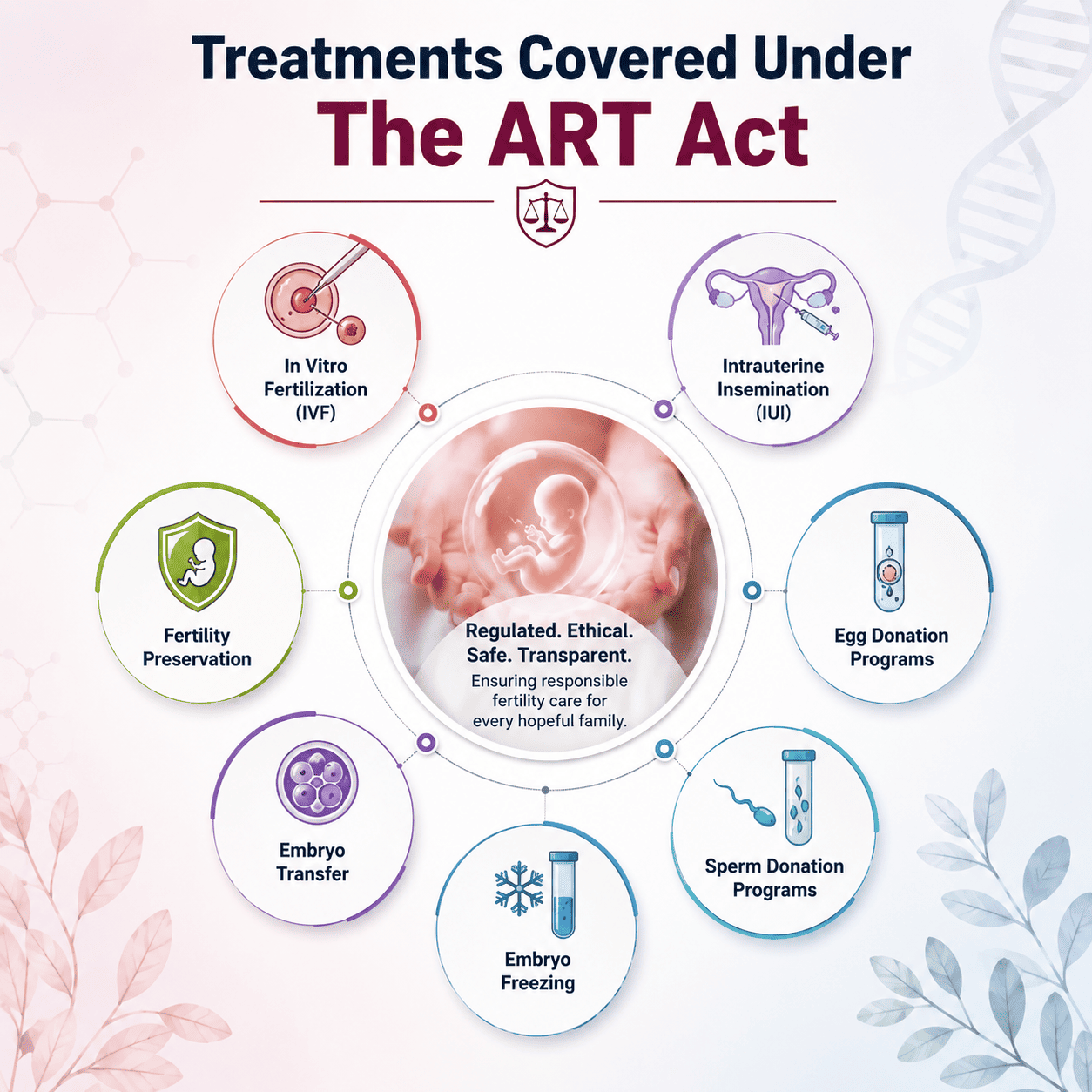
The law applies to a wide range of assisted reproductive procedures, including:
- In Vitro Fertilization (IVF)
- Intrauterine Insemination (IUI)
- Egg donation programmes
- Sperm donation programmes
- Embryo transfer
- Embryo freezing
- Fertility preservation
- Other Assisted Reproductive Technology (ART) procedures
Age Eligibility for IVF Under the ART Act
One of the most important provisions of the ART Act is the eligibility criteria based on age.
At the time the ART treatment is performed:
- The wife must be below 50 years of age.
- The husband must be below 55 years of age.
If either partner exceeds the prescribed age limit, fertility treatments covered under the ART Act cannot be legally offered.
These limits are intended to improve maternal health, reduce pregnancy-related risks, and enhance the chances of healthy outcomes for both mother and child.
Why Are Birth Certificates and Age Proof Required?
The ART Act places significant importance on proper documentation.
Before treatment begins, fertility clinics must verify the age of both partners using valid government-issued documents such as:
- Birth Certificate
- Aadhaar Card
- Passport
- PAN Card (where applicable)
- Other accepted proof of date of birth
These documents become part of the patient’s medical and legal records and help ensure compliance with government regulations.
Mandatory Medical Tests Before IVF
The ART Act also specifies essential health screening before fertility treatment begins.
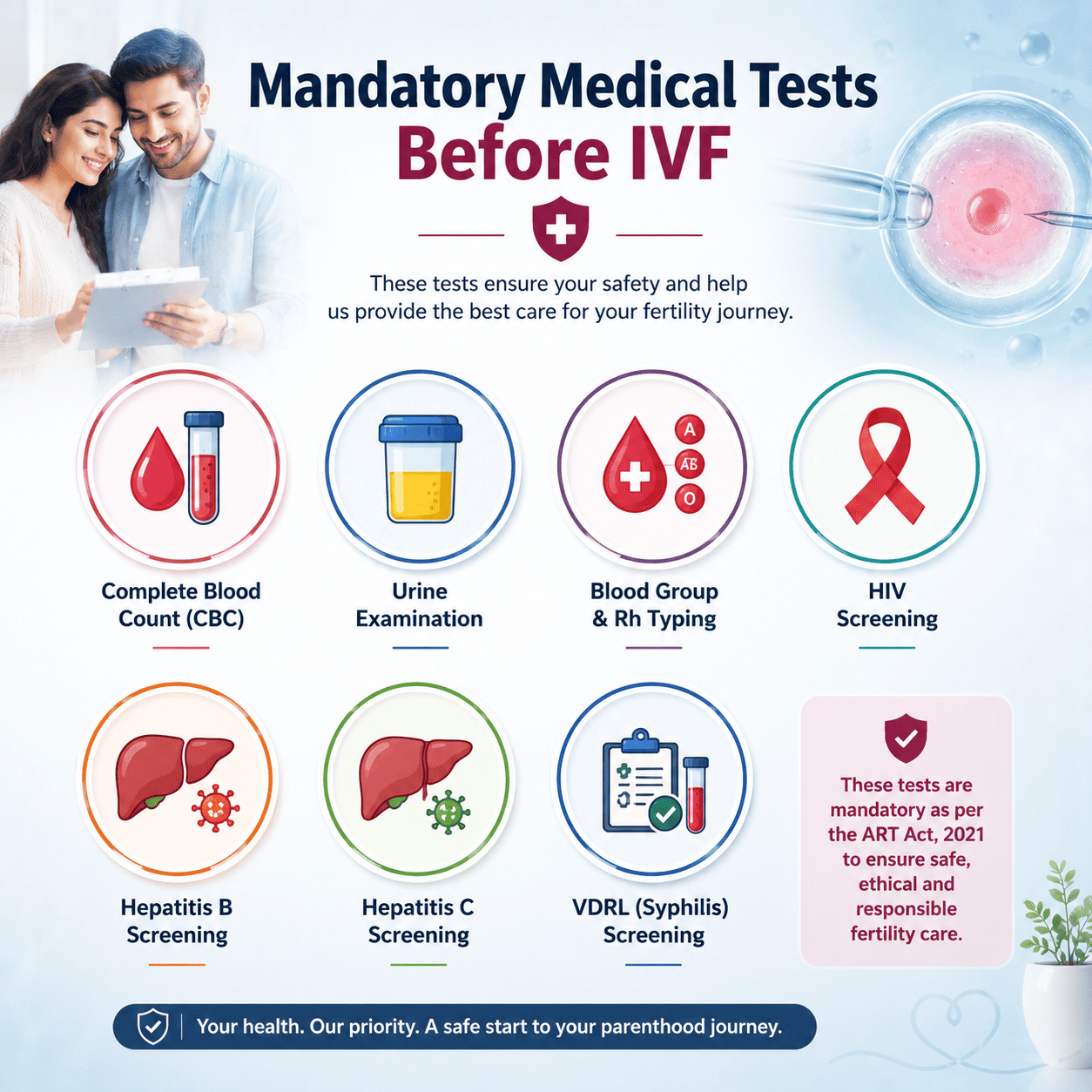
Common mandatory investigations include:
- Complete Blood Count (CBC)
- Urine examination
- Blood group and Rh typing
- HIV test
- Hepatitis B screening
- Hepatitis C screening
- VDRL (Syphilis screening)
These tests help protect both partners, reduce the risk of infection, and ensure safe fertility treatment.
Depending on individual medical history, additional investigations may also be recommended.
Regulations for Egg and Sperm Donation
The ART Act has introduced strict regulations for donor-assisted reproduction.
When donor eggs or donor sperm are used:
- Legal consent is mandatory.
- Proper documentation must be maintained.
- Registered ART banks must follow government-approved protocols.
- Donor confidentiality must be protected.
The law also regulates donor eligibility and establishes safeguards to prevent misuse of donor programmes while ensuring ethical reproductive practices.
These provisions benefit both recipient families and donors by maintaining transparency and accountability throughout the treatment process.
Registration of IVF Clinics Is Now Mandatory
Under the ART Act, every fertility clinic and ART centre must be officially registered before offering assisted reproductive treatments.
Registration confirms that the clinic:
- Meets prescribed infrastructure standards
- Employs qualified fertility specialists
- Maintains approved embryology laboratories
- Follows standardized treatment protocols
- Maintains proper patient records
- Complies with government regulations
Patients can therefore expect greater consistency, safety, and quality of care from registered centres.
National Registry and Record Keeping
One of the major improvements introduced by the ART Act is centralized monitoring.
Registered fertility clinics are required to maintain detailed treatment records and submit the necessary information to the designated national authorities as required by law.
This system helps:
- Improve quality standards
- Monitor treatment outcomes
- Maintain accountability
- Support healthcare planning
- Strengthen regulatory oversight
At the same time, patient privacy and confidentiality remain protected under applicable regulations.
How Does the ART Act Benefit Patients?
For couples planning IVF or other fertility treatments, the ART Act offers several important advantages.
These include:
- Greater transparency in treatment
- Ethical medical practices
- Standardized clinical protocols
- Regulated donor programmes
- Better patient safety
- Improved documentation
- Enhanced accountability of fertility centres
- Increased confidence in assisted reproductive care
The Act ensures that fertility treatment is not only medically advanced but also legally protected.
Key Takeaways
- The ART Act regulates IVF and all major assisted reproductive treatments in India.
- Women undergoing ART treatment must be below 50 years of age.
- Men undergoing ART treatment must be below 55 years of age.
- HIV, Hepatitis B, Hepatitis C, CBC, urine tests, blood grouping, and VDRL screening are mandatory before treatment.
- Donor programmes are governed by strict legal regulations.
- Every ART clinic must be registered under the Government of India.
- Proper documentation and record maintenance are legally required.
- The law promotes ethical, transparent, and standardized fertility care.
Why Choosing a Registered ART Centre Matters
For couples facing infertility, selecting a registered and experienced fertility centre is just as important as choosing the right treatment.
A clinic operating under the ART Act follows standardized protocols, maintains high laboratory standards, adheres to ethical practices, and ensures complete legal compliance throughout the fertility journey. This gives patients greater confidence that every step of their treatment is being carried out according to nationally accepted medical and legal standards.
Experience Matters in Fertility Care
Reproductive medicine has evolved tremendously over the past four decades. Alongside advancements in IVF technology, India has also developed a strong legal framework to safeguard patients and improve treatment quality.
Dr. Satish Patki, one of the pioneers of reproductive medicine in Kolhapur, has been practicing for over 40 years and was associated with the birth of Kolhapur’s first IVF baby in 1996. His experience spans the evolution of fertility treatments—from the early years guided by ICMR recommendations to today’s regulated environment under the ART Act.
At Patki Hospital, Kolhapur, every assisted reproductive procedure is performed in accordance with the Assisted Reproductive Technology (Regulation) Act, 2021, ensuring ethical practices, legal compliance, patient safety, and evidence-based fertility care. The hospital remains committed to helping couples pursue parenthood with transparency, compassion, and clinical excellence.
Frequently Asked Questions on ART Act 2021
The ART Act is a government regulation that governs IVF and assisted reproductive treatments by establishing legal standards for fertility clinics, donor programmes, and patient care.
The woman should be below 50 years of age, and the man should be below 55 years of age at the time of treatment.
Yes. Investigations such as CBC, HIV, Hepatitis B, Hepatitis C, blood group, urine examination, and VDRL are mandatory before starting treatment.
No. Only clinics registered under the ART Act are legally permitted to provide assisted reproductive treatments.
Yes. The Act provides detailed legal guidelines for donor eligibility, documentation, consent, confidentiality, and the operation of registered ART banks.